


Is Canada On Track for Justice?
Oblate Parishes Support Development and Peace
Caritas Canada’s 2026 Fall Campaign
It seems like a lifetime ago when the Canadian bishops decided to change their church’s observance of Lent…As a child in the 1960s, I vaguely remember how those 40 days used to be marked by no chance to eat candy (except maybe on Sundays!) fasting between meals, and fish dinners every Friday.
But in 1967, in an encyclical called Populorum Progressio (“On the Development of Peoples”) Pope Paul VI declared that “development is the new name for peace.” That encyclical spurred the Canadian bishops to establish an official agency for international solidarity and feature an annual collection on Solidarity Sunday – the fifth Sunday of Lent. For the last six decades, then, our Lenten prayers in Canada have reflected wider horizons.
Now called Development and Peace – Caritas Canada (DP-CC), most parishioners know of the agency that sends almost $20 million overseas to 59 projects in 39 countries of Asia, Africa and Latin America. What some may not so easily acknowledge however, is that education and action in Canada has always been a defining feature of DP-CC’s mandate from the bishops. Without community action to change unjust policies and lingering colonial structures (both at home and abroad) mere financing of small projects in foreign lands will never succeed in creating a fairer world or a more sustainable global environment.
So, DP-CC regularly invites participation in a Fall Campaign of education and advocacy. And the autumn 2026 campaign has two main objectives.
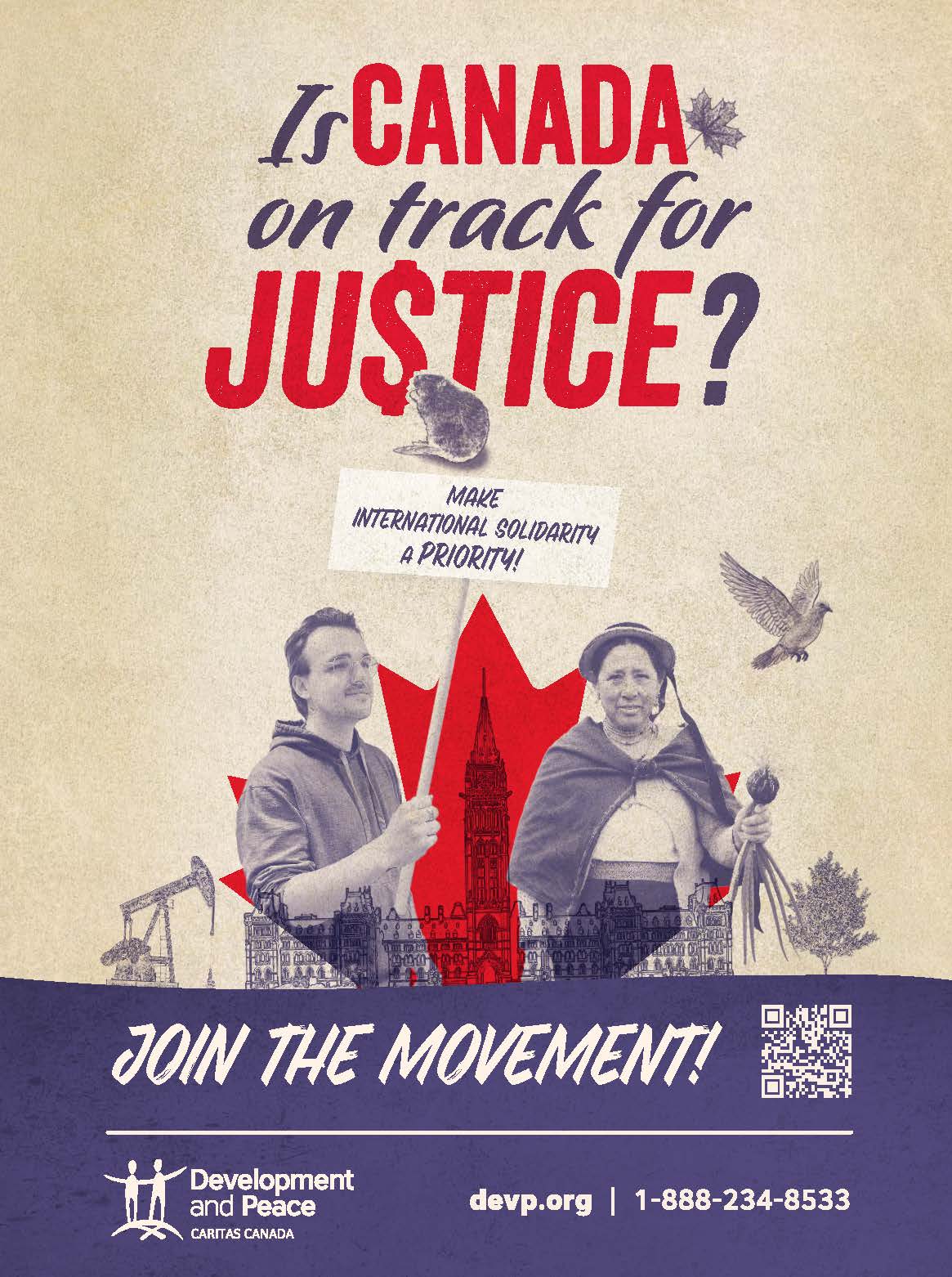
The first objective is to recruit new members in DP-CC. Many parishioners may already consider themselves “members” because we’ve donated to Share Lent campaigns in the past. Readers may even be aware that among the four bishops serving on DP-CC’s National Council is the Oblate bishop of Hearst-Moosonee, Pierre Olivier Tremblay OMI. But it is time for individuals to officially sign up so that a firm and growing membership base allows the agency to influence policymakers and negotiate partnership arrangements with funders like Global Affairs Canada and charitable foundations.
Just for fun…try to guess how many members you think DP-CC has? Note that there are over 12 million Catholics in Canada, and the CWL has 55,000 members. (To see the answer, peek at * the bottom of this article!)
Postcards are available for your fellow parishioners to print, sign and send to the DP-CC office. One enterprising nun signed up 200 new members by taking postcards to her diocesan CWL Convention!
Or, you can immediately join on-line. For the duration of the campaign, until February 10, 2027, membership in the movement is free.
The second objective of the 2026 Fall Campaign is to raise awareness of Canada’s cuts to overseas development assistance. At a time of great need, our federal government has slashed overseas development finance – a concern that Canadian bishops raised with the Prime Minister during their May meeting with him.
During the election campaign of April 2025, Mark Carney declared clearly: “My government will not cut foreign aid.” Yet, the November 2025 federal budget announced cuts to Overseas Development Assistance of $2.7 billion over the next 4 years. The November 5, 2026, federal budget did nothing to reverse these cuts.
Current spending on ODA stands at about 0.32% of Gross National Income – well short of the international promise of donor countries to reach 0.7% of GNI. (Four countries have reached this target, and 8 donor nations increased ODA spending this year.) Sadly, Canada has no plan to get to 0.7%, which would amount to $20 billion annually. That seems like a huge amount of money – until we consider that federal subsidies for the fossil fuel industry in 2025 reached $10.2 billion; or that the estimated cost of the West Coast Pipeline will easily be $35 billion; or that military spending is promised to reach 5% GDP or $150 billion per annum! (The Globe and Mail reports that each Canadian is already spending US$1,146 on military expenditures in 2026.)
It is important to recognize that not all aid is beneficial to the poor or ends poverty or protects the environment. Structural injustices must be recognized – and rectified. Canadian civil society organizations (like DP-CC, OXFAM Canada, etc.) only receive 19% of Canadian ODA, while fees to UN and multilateral agencies make up most federal government donations. Official figures include large sums for other purposes you may be unaware of, like helping Ukraine or even settling refugees in Canada. Nonetheless, such massive federal cuts may limit the ability of groups like DP-CC to continue supporting all their partners. When hard choices must be made, experience shows that building up social movement partnerships (in Canada and abroad) is the most likely strategy to overcome injustice.
How many DP-CC members could be signed up at your own parish?
Will you write your Member of Parliament to encourage support for international development?
All parishioners are invited to join Development and Peace – Caritas Canada’s Fall Campaign!
From his home in Ottawa, Joe Gunn is the volunteer representative of the Canadian Religious Conference on DP-CC’s International Programs Committee.
*DP-CC had 13,500 members in Canada as of this writing.
By Joe Gunn