

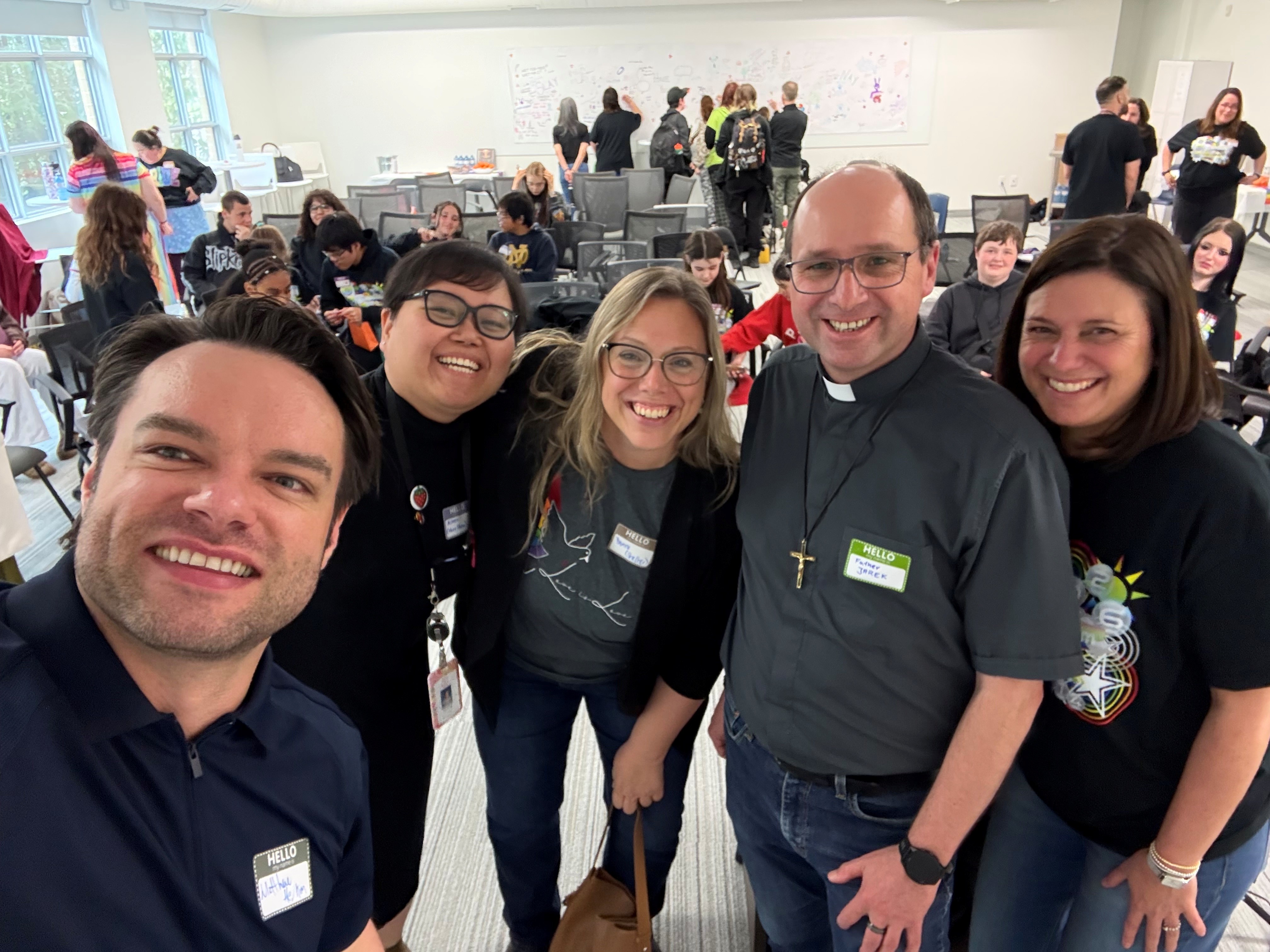
The Cost of Daring in a Prophetic Church
Have you ever wondered what happens when a prophetic mission leads us close to the margins? I often return to a simple image for the way I am trying to do my pastoral outreach: colour within the lines, but stay as close to the margins as possible. It sounds almost playful – until you realize that the margins are not empty. They are crowded with people who have been overlooked, judged, spoken about, or pushed aside. And once you stand near them, the edge of the page can become a costly place to remain.
OMI Lacombe Canada names the call with striking honesty. It does not present daring as a slogan for a poster or as a heroic word from another age. It describes a way of standing in the world:
“As daring members of the prophetic Church, we stand with the voiceless, hearing and making heard their cry, which is a cry to God who brings down the powerful and lifts up the lowly. In so doing, we risk finding ourselves among the marginalized of our community, our society and our church…” – OMI Lacombe Canada Mission Statement
We often quote the first sentence with pride. The second sentence is harder. It is not a decorative ending. It is a warning: if we truly hear the cry of those who are excluded, and if we dare to make that cry heard, we may lose the comfort of standing at the centre. We may discover that the price of solidarity is becoming suspect ourselves.
Reflecting on the Oblate Constitution 7 begins an important insight: the spirituality of St. Eugene de Mazenod is relational rather than merely doctrinal. This does not make doctrine unimportant. It means that faith must lead somewhere – into a living relationship with Christ and, through Christ, into a real encounter with people. Eugene’s life changed when he discovered the unconditional love of God. His mission became a response to having been loved.
“Charity includes everything; and in case of fresh needs, it invents new means, if necessary.” – St. Eugene de Mazenod, Pastoral Letter, 7 February 1847
That sentence contains the heart of daring. Love does not wait for perfect conditions. Love pays attention. When an old method no longer reaches people, charity does not abandon them; it finds another way. When familiar language no longer communicates hope, charity learns a new language. When the path to a wounded person lies beyond the boundaries of respectability, charity crosses the distance.
My own understanding of daring changed when the people at the margins were no longer an idea or a ministry category. They were people with names, stories, families, prayers, and wounds. Once I listened, I could not pretend that their exclusion and suffering were abstract. Once I saw the harm caused by prejudice and exclusion, compassion made neutrality impossible.
Standing near them came at a cost. The pressure did not come from strangers or from people outside the Church. It came from within circles where I expected fraternity and understanding. My intentions were questioned. Efforts were made to damage my life, mission, and reputation. Eventually, I was told to be silent.
There is no need to romanticize that experience. It hurt. It still hurts. Being wounded by people who speak the language of holiness carries a particular kind of grief. It is not only the loss of a public voice; it is the loss of trust, belonging, and the hope that shared faith would make honest conversation possible. John Green’s words capture something I have struggled to explain: “The truth is that it hurts because it’s real. It hurts because it mattered.” The pain is not proof that the mission was mistaken. It is evidence that the people, the calling, and the relationships mattered deeply.
It would be easy to tell this story by dividing everyone into heroes and villains. Life is more complicated. People can sincerely believe they are protecting the Church while causing real harm. Prophetic courage must name harm truthfully without surrendering to hatred. Otherwise, the fight for dignity can slowly reshape us into the very hardness we oppose.
I have had to learn the difference between being silenced and becoming indifferent. Others may place limits on what I can say publicly, but no one can command the heart not to notice. Compassion cannot unsee suffering, bigotry, or injustice. It cannot forget the faces of people who trusted us with their stories. It cannot turn a neighbour back into an issue.
So I return to that image: colouring within the lines, but close to the margins. It is not the freedom I would choose, and it is not a clever way of pretending that the limits do not exist. It is a decision to remain near. I can still listen. I can still accompany. I can still protect dignity in ordinary encounters, offer pastoral care, pray, learn, and refuse to let imposed silence become emotional absence.
There is a cost to daring. Sometimes it is misunderstanding. Sometimes it is the loss of approval. Sometimes it reaches into one’s life, mission, and reputation. We should say that honestly, especially to those who are trying to live prophetically and are surprised when faithfulness does not protect them from rejection.
St. Eugene’s call to leave nothing undared was not an invitation to recklessness. It was an invitation to let charity become imaginative, mobile, and brave. The question is not whether we can avoid every cost. The question is which cost we are willing to bear: the cost of standing near those who are pushed aside, or the cost of abandoning them for the sake of our own safety.
For now, I will keep colouring within the lines – but as close to the margins as I can. I will keep listening, loving, learning, and standing near. The pain is real because the mission matters. And perhaps this is the deepest meaning of daring: not the absence of fear or wounds, but the refusal to let either have the final word.
By Jarek Pachocki, OMI