
Before it All Makes Sense
Third Sunday of Easter (Luke 24:13-35)
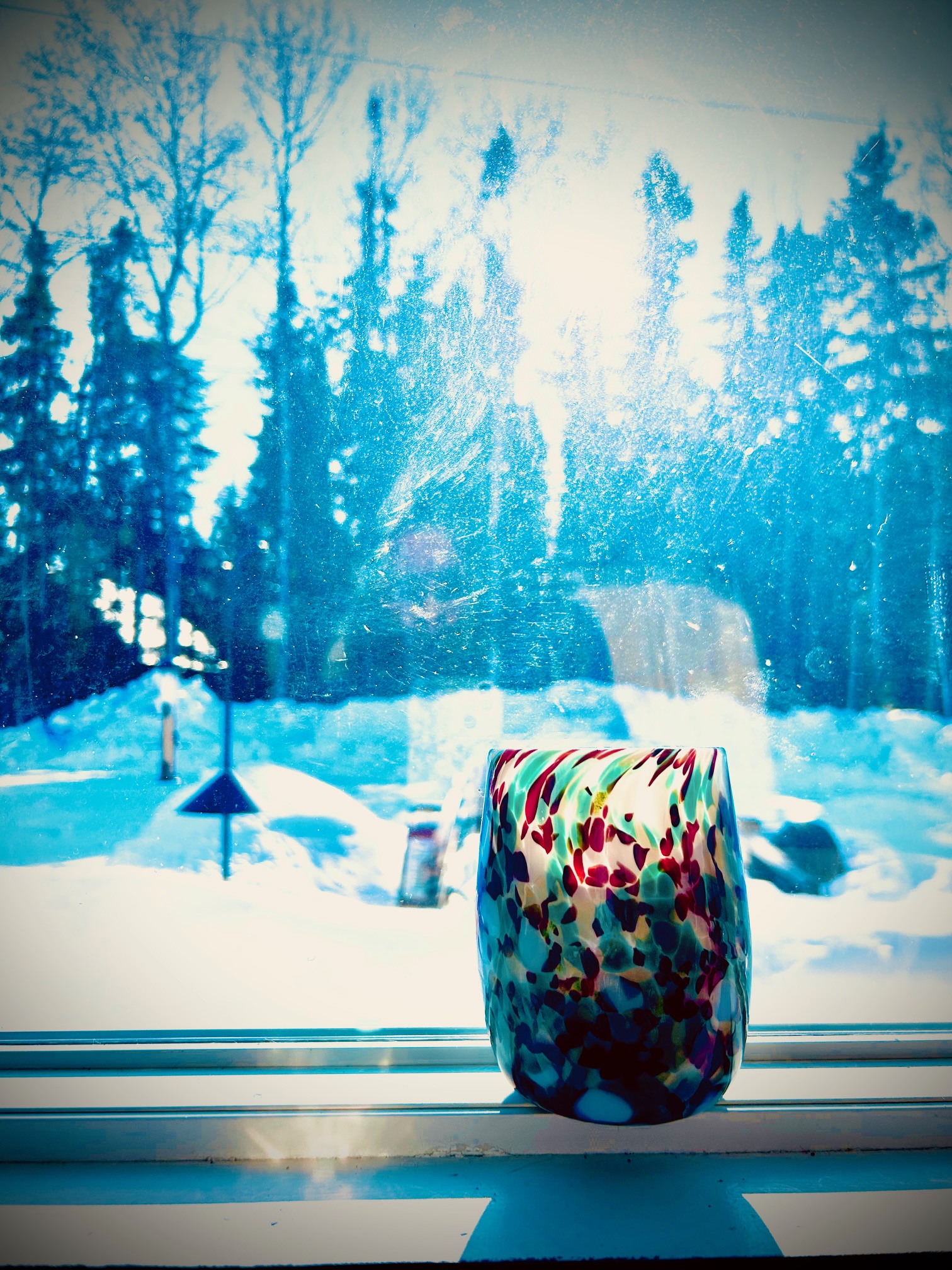
I am blessed to have a cottage in the deep forest of northern Saskatchewan and a job that afforded me a few days off after Easter. The day after a heavy April snowstorm, I found myself sitting in my favourite spot – in silence, in the sunshine of a south-facing window, watching my bird feeder.
But nothing about that moment made any sense.
I was drinking wine out of a hand-blown glass resplendent in greens and reds and whites – Christmas colours. I had put out seeds for my resident squirrel, who promptly ignored them in favour of trying to defeat the squirrel-baffle-protected bird feeder (which, incidentally, contained the exact same seed). A chickadee resolutely ignored the overflowing feeder altogether and instead went for the stale bread I had put out for the whiskey jacks – ordinarily opportunistic little thieves who, on this particular afternoon, were nowhere to be found. A woodpecker appeared just often enough to get my attention, but not long enough for me to determine what kind of woodpecker it actually was. Meanwhile, a nuthatch kept returning to the suet feeder, supremely unconcerned about all of this.
And all the while, there I sat: holding a now-empty Christmas glass, sweating in the direct sun that plainly contradicted the six-foot pile of snow in front of me, thinking, there is either some deep theology in this, or it makes no sense at all.
And maybe, right there, is the very crux of Emmaus.
The story of the disciples on the road to Emmaus reminds us that resurrection does not arrive all at once for us. It arrives while we are walking – confused, hearts warming, not entirely sure what we’re seeing.
In the Emmaus story, the disciples have all of the facts and none of the clarity. They know the tomb is empty. They have heard the testimonies. And still, they walk away from Jerusalem, disoriented, disappointed, hope unresolved. None of it makes sense.
And in all of this, Jesus walks beside them. Present. Real. Risen. Yet they don’t recognize him. Their hearts respond long before their understanding catches up.
Watching the bird feeder that afternoon felt strangely familiar. Everything was responding to something very real. But at the same time, it was all so difficult to understand: the almost unbearable warmth of the sun shining on lingering snow, birds and squirrels acting on instinct but defying expectation, my own body seeking and settling in the light before my mind could make sense of the season.
Nothing was wrong. But nothing had stabilized yet.
Perhaps this is what it feels like to live inside resurrection before it organizes itself.
Emmaus suggests that resurrection is not something we immediately understand, but something we learn to live into, step by step, as our hearts warm faster than our certainty. Clarity, it seems, is not the first gift of Easter.
The story of Emmaus is the Gospel for exactly this kind of moment – when resurrection is true, light is real, life is returning, and nobody – bird, squirrel, or human drinking Easter wine from a Christmas glass – quite knows how to respond yet.
By Darcie Lich