
Indigenous-led clean energy projects could help clean up Canada’s grid, say advocates
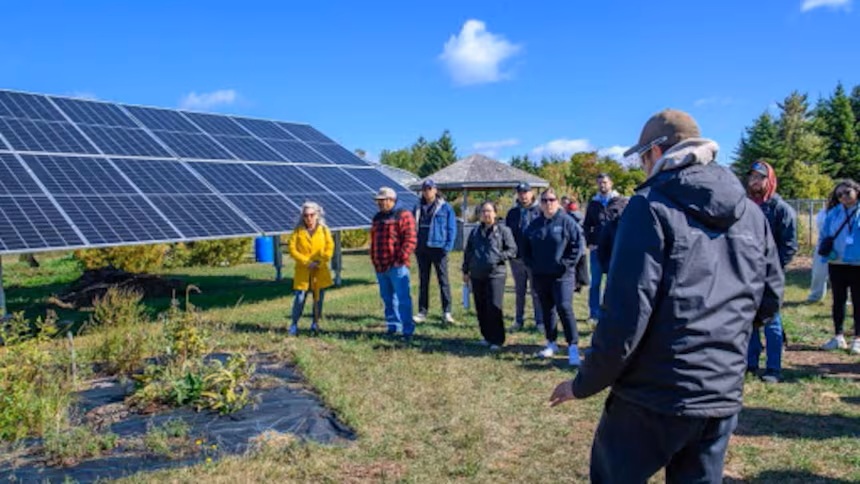
Pictured left: Participants in an Indigenous Clean Energy program visit a solar-powered greenhouse in Lennox Island First Nation on P.E.I. (Submitted by Indigenous Clean Energy)
Report suggests Canada has moved further away from its climate targets since 2023
Indigenous-owned or co-owned renewable energy projects have a role to play in helping Canada come closer to reaching its climate targets, says one advocate.
James Jenkins, executive director of Indigenous Clean Energy, a not-for-profit that supports Indigenous-led clean energy projects at the community level, said Indigenous-owned or co-owned renewable energy projects increased over the last decade.
“Every project that’s not emitting does help Canada reach that target,” said Jenkins.
Data released from Environment and Climate Change Canada in December suggests Canada will fall well short of its 2030 climate goal — just halfway to its target of a 40 to 45 per cent reduction in greenhouse gas emissions below 2005 levels.
Jenkins, a member of Walpole Island First Nation in southwestern Ontario, said among the growing list of operations are hydroelectric, wind and solar projects, and battery storage. Renewable generation can generate revenue which is then reinvested into community, he said.
Jenkins said generally, there’s alignment between community values and these kinds of projects.
As of 2022, the Canada Energy Regulator website said First Nations, Métis and Inuit were partners or beneficiaries in about 20 per cent of Canada’s existing electrical-generation infrastructure.
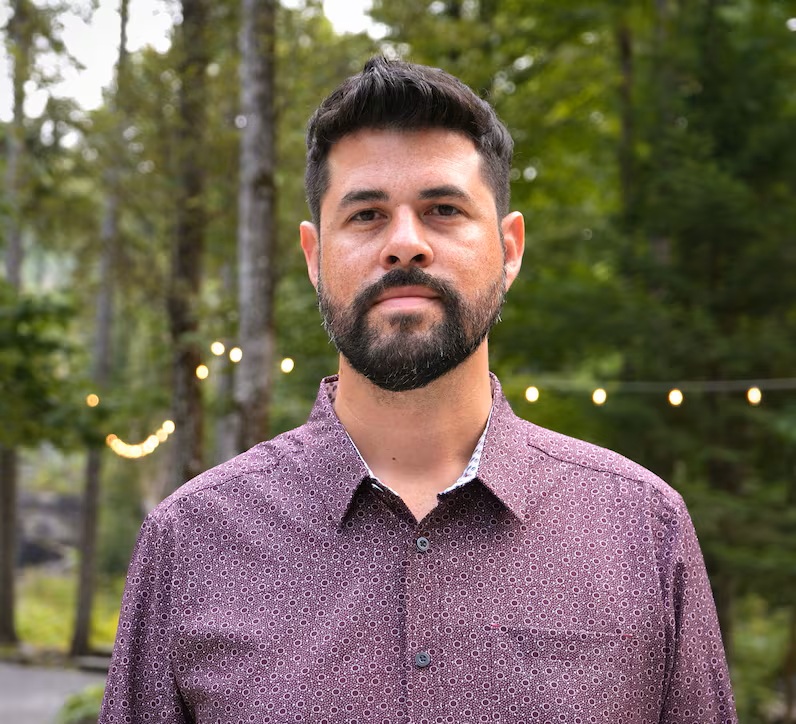
James Jenkins, executive director of Indigenous Clean Energy, says the impacts of climate change are felts at the community level in ways like harvesting rates and food security. (Submitted by Indigenous Clean Energy)
The website said as of 2022 the number of renewable projects on traditional Indigenous territory or reserve lands quadrupled between 2009 and 2020.
Six Nations of the Grand River Development Corporation and Mississaugas of the Credit Business Corporation are among the partners in Oneida Energy Storage, a lithium-ion battery energy storage facility.
According to the website of Northland Power, the project’s majority owner, it is the largest grid-scale battery energy storage facility in Canada and is expected to reduce emissions by between 1.2 to 4.1 million tonnes, the equivalent to taking up to 40,000 cars off the road.
CBC Indigenous reached out to Northland Power for comment but did not receive a response by publishing time.
Jenkins said leadership at the federal, provincial and territorial levels needs to continue this positive trajectory in areas like federal grants for the construction of Indigenous-led projects.
He said many provincial governments are predicting a sharp increase in demand for electricity over the next 10 years.
“Indigenous communities have been trusted partners in Canada and while many of us feel very frustrated through the process, working at it on the day-by-day level and on the ground as a whole, it’s been a real success story,” Jenkins said.
Canada not on track to meet climate targets
Ross Linden-Fraser, research lead of 440 Megatonnes, a data project at the Canadian Climate Institute tracking climate policy, said Indigenous nations have been “at the forefront of some of the really encouraging developments in clean electricity.”
He co-authored a recent Canadian Climate Institute report assessing the federal government’s report on progress toward the 2030 emissions reduction target that suggests Canada has moved further away from its climate targets since 2023 because the federal and provincial governments have removed or weakened climate policies.
“If Canada, a wealthy, high emitting country, is not contributing to global efforts to reduce greenhouse gas emissions, that global effort is going to be weaker and we’re going to have a harder time as a world trying to avoid these climate impacts,” he said.

Ross Linden-Fraser, research lead of 440 Megatonnes, a data project at the Canadian Climate Institute tracking climate policy, says Canada h as moved further away from its climate targets since the last time they did an analysis. (Submitted by Ross Linden-Fraser)
Canada’s net-zero emissions accountability act says if the projections show Canada is not on track, then the government has to show some options for ways that it could get more progress in the years ahead, he said.
Canada’s report in areas on policy updates and emissions projections were comprehensive and reasonably transparent and plans for improvements or “signs that Canada is building a cleaner, more resilient economy” were included, Linden-Fraser said.
“Where the federal government report really fell short is in providing a substantive assessment of options to correct course,” he said.
Linden-Fraser said last year Canada was one of the world’s top 10 emitters of greenhouse gases.
A statement from the Office of the Minister of the Environment and Climate Change pointed to the Darlington nuclear expansion, the North Coast Transmission Line project and hydroelectric projects in Iqaluit as examples of federal efforts to reduce greenhouse gas emissions.
The statement also pointed to the most recent federal budget, which introduced the Canada Climate Competitiveness Strategy, as one way it’s trying to reduce emissions.
“This includes the new methane regulations, strengthened industrial carbon pricing, $90 billion in investment tax credits to drive clean growth, support for critical minerals projects, and the mobilization of capital for the transition to net-zero,” the statement said.
By Candace Maracle
Published on the CBC News website
