

Platform launches to keep church money out of mining projects
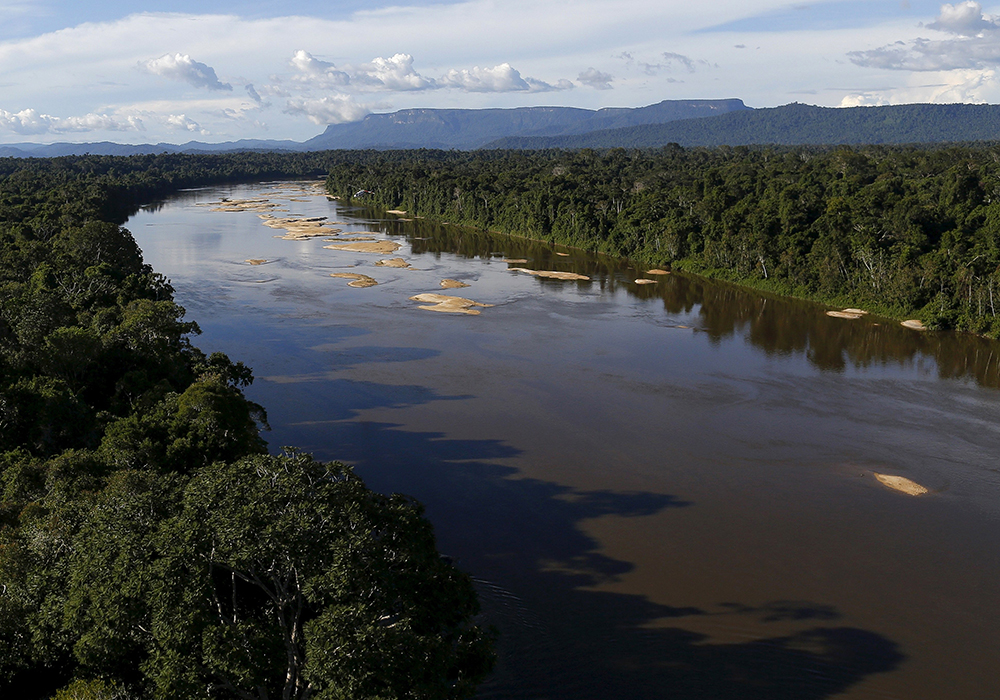
Picture left: The Uraricoera River is pictured in a file photo during a Brazilian government operation against illegal gold mining on Indigenous land in the heart of the Amazon rainforest. (CNS/Reuters\Bruno Kelly)
Even without intent, the church’s financial resources can be tied to mining projects that pollute ecosystems in the Global South and fracture local communities.
“Our preferential option for the poor and for the defense of creation cannot be intimidated by the seductions of money,” said Bishop Vicente Ferreira of Livramento de Nossa Senhora, Brazil.
The bishop, an adviser to the Churches and Mining Network, spoke at the Vatican March 20 to launch a new mining divestment platform organized by CIDSE, an international association of Catholic development agencies, which aims to push church institutions to scrutinize and ultimately withdraw their investments in the mining sector.
The initiative seeks to bring Catholic investment practices into closer alignment with church teaching, drawing on Pope Francis’ 2015 encyclical “Laudato Si’, on Care for Our Common Home” and Mensuram Bonam, a Vatican framework offering guidance for Catholic investors.
It falls in line with broader church efforts to help investors consider their holdings from a moral perspective. Last month (February), the Vatican launched two equity indexes to track stocks that meet investment guidelines drawn from Catholic social teaching.
In the case of mining, organizers said the church’s financial ties are often indirect. Funds held in banks or investment portfolios can be channeled into mining companies through loans and other financial instruments, often without the knowledge of the institutions providing the capital.
The platform aims to shed light on the often hidden ties between the financial sector and mining operations in the Global South, and to prompt church institutions to examine their investments to ensure they are not supporting such projects.
Cardinal Álvaro Ramazzini of Huehuetenango, Guatemala, spoke firsthand about the extractive processes used to procure gold and silver in his former diocese of San Marcos by the Canadian mining company Goldcorp.
“Their strategy from the beginning was to go along unnoticed” by the local community, which was largely Indigenous, he said, while operating with government support. After the company left, “that town stayed just as poor as before.”
“That is the challenge: to make governments and business owners understand that what is legal does not always correspond to the value of justice, and in terms of integral ecology this gains an ever greater importance,” the cardinal said.
Yolanda Flores, an Aymara Indigenous leader in Puno, Peru, described how contamination from mining has seeped into water and food supplies.
“Instead of feeding her child, a mother must ask if she is poisoning him,” Flores said. “The great question is: Who is financing this? Who is giving money to poison us?”
She said the church must unite more closely with affected communities and help advocate for change.
“We want our bishops, our parish priests, to not only dedicate themselves to the sacraments but to be joined with us, to orient us, to walk with us,” Flores said.
Comboni Missionary Fr. Dario Bossi, coordinator of the Churches and Mining Network, said the platform invites churches, religious congregations and other faith-based and social organizations to review where their resources are invested and divest from companies linked to mining practices.
Participating institutions are first encouraged to study the impacts of mining, then to revise their ethical investment guidelines and, ultimately, to remove or prohibit investments tied to the sector.
Since recent conflicts and energy crises have only opened the path for mining projects to expand, Cardinal Fabio Baggio, undersecretary of the Dicastery for Promoting Integral Human Development, said that discussions in the international community “seem to us to be turning back on some commitments that have been made.”
In that context, looking to the Gospel “should push us always to do the right thing, and to see even the question of statism and the issue of mining within a larger perspective of stewardship, of the administration that is entrusted to the human family since the beginning.”
By Justin McLellan
Publishes on The National Catholic Reporter website