

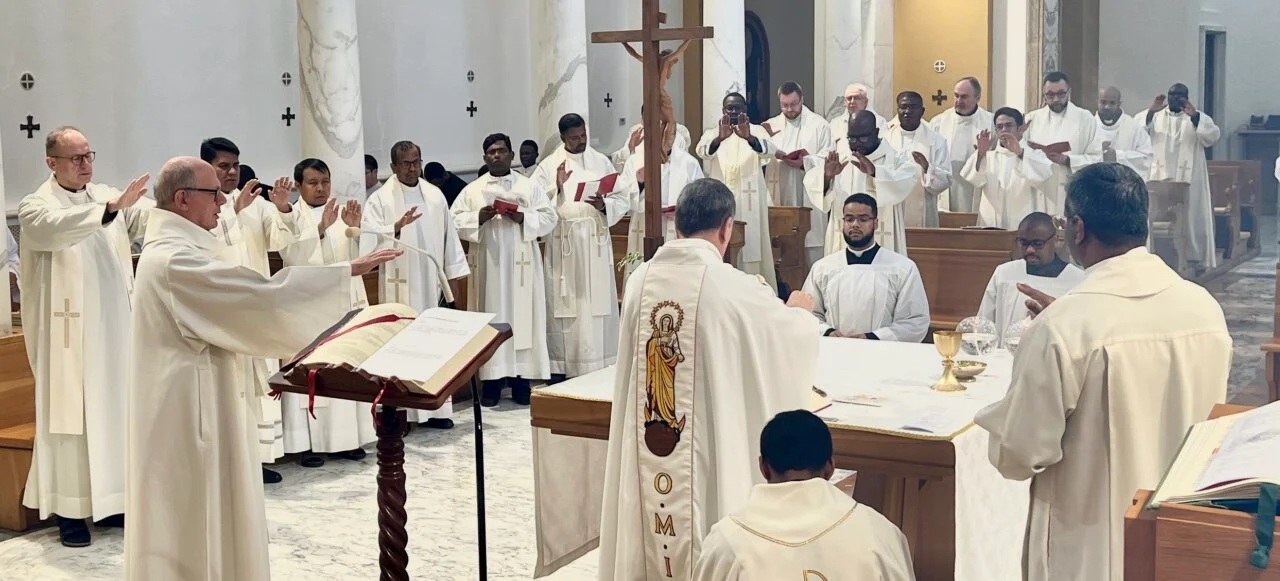
Returning to the Heart of Our Charism: Homily of the Superior General
In his homily marking the 210th anniversary of the origin of our community and missionary life, and in the year of the bicentenary of pontifical approval, the Superior General spoke of this jubilee time as an opportunity to return to what is at the heart of our charism.
He recalled the fragile beginnings of the Congregation and affirmed that the approval itself can be read as an act of God’s Providence, a grace that calls for a response today. From there, he pointed to three core pillars that must be safeguarded and developed: oblation in communion with Christ the Oblate, community life lived as family and marked by charity, and a shared mission with the poor, carried out with them. We invite you to read the full homily and to live this bicentenary with gratitude, prayer, and joy to the gift entrusted to us.
Homily – 24 January 2026
210th anniversary of the beginning of our community and missionary life
Dear Brothers,
Today we celebrate the 210th anniversary of the beginning of our community and missionary life. We do so in 2026, the year in which we also mark the bicentennial of our pontifical approval. As we hold these two moments together, I am drawn back to the first ten years of our history, a time that shaped who we are.
In 1826, our Institute was a small group of eighteen members. Several had already left, including some of the pioneers, and the community faced opposition from certain bishops and members of the clergy. The Society that Pope Leo XII would approve was, in the Founder’s own words, weak, small, poor, and modest. And yet, there was something within it that moved the Pope to approve it.
Certainly, the Oblates had put everything on the line to preach the Gospel to the most abandoned, and the method introduced by De Mazenod and his companions was bearing fruit. The Founder’s personal charism may also have played a role: a French prelate who spoke Italian and who had assisted the cardinals during their exile in Paris while still a seminarian. The ecclesial context of the time may have contributed as well. But was all of this enough to justify the approval of the Institute?
Saint Eugène de Mazenod read this approval as an act of God’s Providence. We, too, can read it in this way. And if this approval was willed by God, then it is right for us to ask ourselves: what was it about our Society that received this grace? What was planted in Aix that could grow into the tree we know today, 210 years later?
This Jubilee year gives us a privileged opportunity to return to what is essential in our charism. Each of us is called to take this question personally, listening for what God is saying and what He is asking of us. To believe that our charism comes from God draws us more deeply into this discernment, because we must discover how to respond to His grace. That response calls us to give the best of ourselves. Today, it is our responsibility to develop the charism with creative fidelity. What are the essential elements we must safeguard and allow to grow if we are to remain faithful to the vocation we have received?
- Oblation in communion with Christ the Oblate
The desire that brought our first fathers together was simple and demanding: to serve the Lord by striving to be like Him. This desire was born from a personal encounter in which God came to occupy first place. In his letters to those he invited to join him, the Founder asked them to “read this letter at the foot of the crucifix” and to place every other concern in second place. Their encounter with the Crucified led them to set aside their own agendas.
This experience gradually took concrete form in what we call oblation: the total offering of our lives in communion with Christ. Through oblation, united to the oblation of Christ Himself, Oblates consecrate themselves entirely to the person and mission of the Savior. We live chastity, poverty, obedience, and perseverance with this distinctive note that has given us our very name. Oblation has written heroic pages in the lives of missionaries in the most extreme situations. It has also led some to give their lives, even to the point of shedding their blood, for the Church and for the poor.
If we want our charism to shine today, we must recover this spirit of oblation lived by those who came before us. Our self-giving must once again become a clear sign of unconditional love for Jesus, who stands at the center of our lives, our work, and our desires. To give our lives without any personal agenda other than offering them for the sake of the Gospel, as Jesus did. Today it is our turn to live our relationship with Jesus Christ as Oblates.
- Community life as family
The second great pillar born in 1816 was community life. In the Petition to the Vicars General of Aix, life in common is presented as a means of helping one another become saints by imitating the way of life of the Apostles. The first Oblates wanted to live the spirit of the early Christian communities, whose lives of charity drew others to conversion.
This is the legacy the Founder entrusted to us: “Among yourselves, charity, charity, charity…” This charity is nourished by God, who makes Himself present wherever two or three are gathered in the name of Jesus. We live together, then, to be a sign that God is everything for us and to cooperate in His mission, as the Apostles did with Jesus.
This inheritance challenges us today. Each of us must ask: what am I doing to live charity with greater fervor? Do I make room for my brother in my life and in our missionary discernment? Do I seek reconciliation when I have wounded someone, or when I myself have been wounded? Do I give the best of my time and energy to building up charity among us? Without this essential dimension, we are not the family that Saint Eugene and his first companions began to build. Today it is our turn to live Oblate charity.
- Shared mission
Finally, the missionaries came together to proclaim the Gospel to the most abandoned. Their principal works included preaching parish missions, caring for the young, and serving prisoners. They did not seek privilege or prestige. Hidden away in a marginal region of France, they gave themselves passionately to their ministry, with hearts wide enough to embrace the whole world.
In a world shaped by recognition and constant visibility, this challenges us. It calls us to a humble and persevering service precisely where we “do not count,” because we have chosen to stand with those who do not count.
When Eugene de Mazenod and his companions chose to preach the Gospel in the local dialect, they were doing more than adopting a missionary strategy. They were placing the poor, their language, and their culture before every pastoral technique. They chose to respond to the needs of the poor by becoming one with them. This is not about doing things for the poor from offices or classrooms, even within Church structures. It is about being one with the poor and allowing them to become protagonists of the mission.
Is this not what Eugene de Mazenod lived, both as an Oblate and as a bishop? The mission is carried out with the poor. For this, we must be willing to step into the mud and allow ourselves to be evangelized by them. This is why the Church needs us. The vitality of our family depends on the quality of our response. Today it is our turn to be missionaries of and with the poor.
The seed planted in 1816 matured with the pontifical approval of 1826 and has borne abundant fruit over the past two hundred years. By living what is essential, we too are called to care for this charism tree so that it may continue to serve the Church and the poor by proclaiming the Gospel of Jesus Christ.
We entrust our pilgrimage during this bicentennial to our Mother Mary. We ask her to help us face the missionary challenges of our time without losing our identity. May we grow in love for Jesus Christ through our oblation, grow in charity, and live our mission with the poor with greater humility and passion.
Mary Immaculate, pray for us.
Amen.
Luis Ignacio Rois Alonso, OMI
Superior General
Published on the OMI World website
